
AI Has Changed Project Management. Now It’s Changing the Project Team
AI is moving from project-management assistant to project-team member.
AI & Work | New Stardom
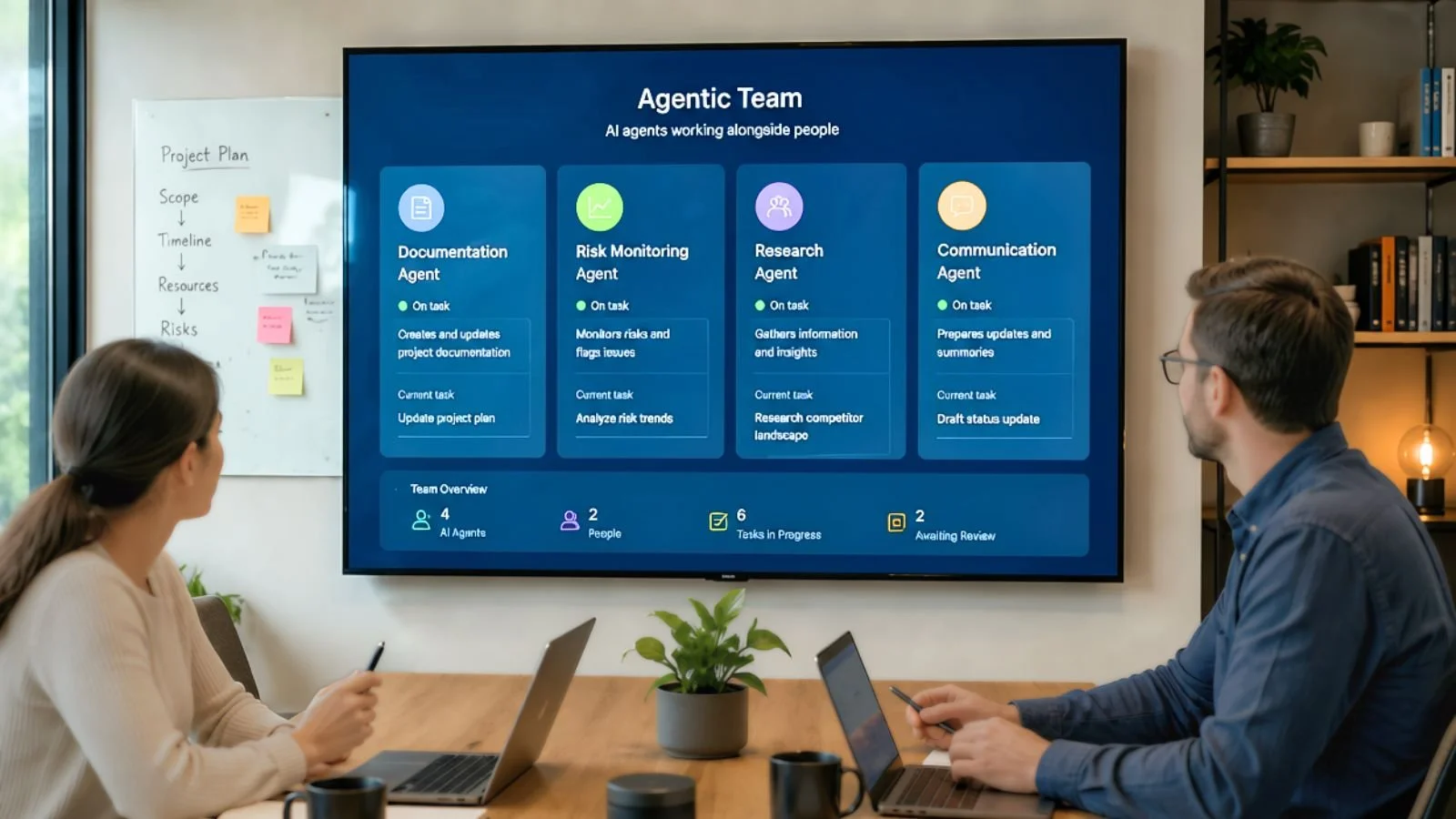
Image AI-generated for New Stardom

Available Now
In June 2026, the Project Management Institute published its Standard for Artificial Intelligence in Portfolio, Program and Project Management, describing it as the first published global standard for applying AI in professional project work. The standard addresses governance, risk, data quality, ethics, legal considerations and human oversight, alongside the use of AI across the project lifecycle.
A month later, PMI was describing AI as already embedded in project work, with teams using it to summarise meetings, generate reports, analyse data, identify risks and support decisions. The organisation's concern was no longer whether project professionals should use AI, but how they should govern its use as adoption moves faster than organisational alignment.
That shift is already visible in the software used to manage projects. Microsoft Planner Agent is generally available and can execute tasks, act on feedback and produce status reports based on plan updates. In Jira, AI agents are generally available as collaborators that can be assigned work, invoked through comments and triggered by workflow transitions. Atlassian describes its Rovo agents as configurable AI teammates that can use connected organisational information and, with permission, create, edit and organise work.
Project management has therefore moved beyond the stage where AI is simply a tool that helps a project manager write faster. AI is becoming part of the machinery through which projects are planned, tracked and delivered, and that raises a more interesting question about what the project team itself will look like.
The administrative layer is already being automated
Project management has always contained a large amount of work that exists to keep the project organised rather than to move its substantive objectives forward. Meetings generate decisions and actions; actions become tasks; tasks require owners, deadlines and updates; progress has to be consolidated into reports; and information has to be moved between documents, project plans and communication channels.
Generative AI has already reduced much of the manual effort involved in processing that information. Meeting transcripts can be turned into action lists, project updates can be drafted from existing information, documents can be compared and summarised, and large amounts of project data can be analysed for patterns and potential risks.
The more important development is that the resulting information can increasingly be fed straight back into the project workflow.
Microsoft's Planner Agent, for example, can be assigned tasks and can execute work, act on feedback and write status reports based on updates to a plan. Microsoft also describes Planner Agent as supporting task assignment, status reporting and task generation from project goals.
That changes the amount of manual coordination required to keep a project current. An action identified in a meeting does not necessarily have to wait for somebody to create the task, assign it and update the plan. Depending on the workflow and permissions, AI can increasingly handle parts of that chain.
The effect on project management is straightforward: routine information processing takes less human time, while the value of knowing what the information means becomes greater.
Project-management software is becoming part of the team
The clearest evidence of the next stage can be found inside the project-management platforms themselves.
Atlassian made Agents in Jira generally available in 2026, allowing teams to assign AI agents to Jira work items, invoke them in comments and use Jira's workflow engine to trigger agents when work moves between stages. Once assigned, an agent receives the context of the work item and can work on it within the permissions available to it.
This is a meaningful change in the role of project-management software. Jira has historically been a system in which people record and coordinate work. With agents, the system can also contain entities that are themselves performing parts of that work.
Atlassian describes Rovo agents as configurable AI teammates with defined objectives and parameters. Depending on their permissions and connected knowledge sources, they can perform specialised actions such as organising, creating or editing Jira work items and Confluence pages.
The language of "AI teammates" can sound like product marketing, but the underlying capability is concrete. An organisation can now create or use an AI agent, give it access to defined information and tools, assign it a task and allow it to carry out work within a project system.
That is already a different operating model from simply giving every employee access to a chatbot.
The project manager's attention is shifting towards exceptions and decisions
When AI systems can maintain more of the routine project information, project managers have less reason to spend their time checking every update, assembling every report or manually moving information between systems. Their attention can move towards the parts of project delivery where interpretation and authority are required.
Consider a delayed milestone. An AI-enabled project environment can identify the delay, examine dependent tasks and identify deadlines that could be affected. An agent may be able to update routine tasks or prepare communications according to predefined rules. The project manager can then assess the consequences and decide whether the proposed response is acceptable.
The distinction is important because project management combines highly structured work with situations that depend on context. Scheduling, documentation, reporting and information processing can be represented in data and governed through rules. Stakeholder negotiations, competing business priorities, organisational politics and decisions involving incomplete information require a different type of judgement.
PMI's own guidance makes this distinction explicit. Its July 2026 guidance says AI can process large volumes of information, identify patterns, surface risks and generate recommendations, while people remain responsible for interpreting outputs and the consequences of decisions.
As AI becomes more capable, that division of responsibility becomes increasingly important rather than less.
Risk management is becoming more continuous
Project risk management has traditionally depended on scheduled reviews, risk registers and the experience of the people running the project. AI can add a much more persistent monitoring layer.
An AI system can examine changes in deadlines, unresolved actions, dependencies, requirements and other project information and identify patterns that warrant attention. Instead of relying entirely on people to notice a developing issue during a meeting or scheduled review, the system can surface potential problems as the underlying project data changes.
The project manager still needs to determine whether the signal represents a genuine risk and what should be done about it. A delayed task can have very different implications depending on the customer, contractual commitments, project dependencies and wider organisational circumstances.
This is precisely why governance has become part of the professional AI conversation. PMI's new standard includes risk, governance and compliance, data quality, ethics and professional responsibility among its eight guiding principles, and explicitly incorporates human-in-the-loop practices for reviewing and acting on AI outputs.
The technology can increase the amount of information available to the project manager. The organisation still has to decide who is accountable for acting on it.
AI agents are already doing project work
The development of agents changes the conversation because an agent can operate within a workflow rather than simply generate an answer.
Atlassian's agents in Jira can be assigned work items and triggered through workflow transitions. Microsoft's Planner Agent can execute tasks and work with plan information. These are already available capabilities rather than predictions about what project-management software might eventually become.
The scope of that work is still constrained. Microsoft's own documentation, for example, notes that Planner Agent is best suited to tasks involving textual or image-based outputs and explains that it cannot independently carry out physical tasks such as building a house.
That limitation is useful context because "agentic" does not mean autonomous project manager. Current agents operate within specific environments, tools and permissions, and organisations still need to determine where human approval is required.
Within those boundaries, however, an agent can take responsibility for a defined piece of project work. An organisation could use one for documentation, another for requirements, another for research or another for routine project administration, provided the underlying systems and permissions support it.
The result is a project team in which not every contributor has to be human.
The project team could become a human-agent team
Once agents can be assigned meaningful work, organisations can start thinking about them as components of the team rather than features of individual software products.
A human project manager might oversee several specialists alongside a collection of AI agents. One agent could maintain documentation and project records, another could monitor defined risks, another could prepare analysis, and another could handle routine communications. Human specialists would remain responsible for expert decisions and work that requires professional or organisational judgement.
The project manager's responsibility would then extend beyond coordinating people. They would also need to design how the agents operate: what each one is responsible for, which information it can access, what tools it can use, what it is allowed to change and when it must escalate a matter to a person.
This is already reflected in how major vendors are positioning their products. Atlassian describes Rovo agents as configurable AI teammates, while its Jira platform allows agents to be assigned work alongside human collaborators.
The shift is significant because it changes the basic unit of project capacity. A team no longer has to measure its available capability only in terms of human hours. Some work can increasingly be delegated to systems that can operate continuously and process information at a scale that would be impractical for an individual employee.
The structure of project teams could change
If AI takes over more documentation, monitoring, analysis and routine coordination, organisations will eventually have to reconsider how project teams are staffed.
A small team supported by several specialised agents may be able to manage work that previously required additional administrative or coordination capacity. A project manager may be able to oversee a broader portfolio because routine monitoring and reporting are handled automatically. Specialists may spend more time on decisions and expert work while agents take responsibility for information-heavy processes around them.
There is also a less obvious consequence for junior project professionals.
People have traditionally learned project management by doing the routine work that surrounds a project. They prepare reports, maintain plans, record decisions, follow up actions and watch experienced project managers deal with problems. If AI performs more of these activities, organisations will need to think carefully about how junior professionals acquire practical judgement.
The skills required at the beginning of a project-management career may consequently change. Familiarity with AI tools will become part of the job, while the ability to assess AI outputs, design workflows, manage stakeholders and make decisions under uncertainty may become more important.
PMI is already adjusting its professional framework in this direction, with its AI standard aimed at project professionals and organisations adopting AI, and its broader AI-related training focused on responsible adoption, governance and operationalising AI projects.
Governance becomes part of the project manager's job
Giving an AI agent access to a project creates a set of management questions that did not exist when AI was simply generating text in a separate application.
Who can create an agent? What project information can it access? Which systems can it use? Can it change a deadline? Can it assign work to another person? Can it send an external communication? Which actions require approval? How are its activities recorded? Who is responsible if its recommendation is wrong or if an automated action creates a problem?
These questions become more important as agents move from recommendations to execution.
A project manager working with several agents may therefore have to think about permissions, escalation rules, audit trails and human approval points in much the same way that organisations already think about access controls and operational processes.
PMI's new standard explicitly places human oversight at the centre of AI-enabled project work and addresses governance, ethics, legal considerations, risk and accountability.
The arrival of agents consequently expands the project manager's responsibilities. The job is no longer only about making sure people know what they are supposed to do. It increasingly includes making sure the AI systems involved in the work know what they are allowed to do.
The next step is connecting agents across the organisation
The most interesting developments ahead are likely to come from connecting project agents with the wider systems that contain the information required to make decisions.
A project rarely exists in one application. Requirements may be stored in documents, discussions may take place in Teams or Slack, customer information may sit in a CRM, financial information may be held in an ERP system and the project itself may be tracked in Jira, Planner, Asana or another platform.
An agent that can access only the project board has limited context. An agent that can work with the relevant organisational information, subject to permissions and governance, has considerably more potential to execute useful work.
Atlassian is already building around this model through the Teamwork Graph, which connects information across its products and connected applications, while its Rovo agents can use organisational and third-party information as context for their work.
Microsoft is taking a similarly integrated approach through Microsoft 365, with Planner Agent operating within the broader environment used for communication, planning and work management.
The longer-term possibility is a project environment in which several agents can monitor different parts of a project, exchange information, perform routine actions and bring significant exceptions to human managers.
That is where the idea of an agentic project team becomes more than a collection of AI features.
Project management is becoming a human-agent discipline
AI has already changed the project manager's working day. Meeting administration, reporting, document analysis, information retrieval, task management and parts of project monitoring can increasingly be handled with AI assistance, while the major project-management platforms are putting AI directly into the systems where work is planned and tracked.
The next stage concerns the composition of the team itself.
Project managers will increasingly need to decide which responsibilities belong with people, which can be delegated to AI agents, how those agents should operate, what information they should have access to and where human approval is required. Their role will increasingly involve designing and supervising a working system in which human expertise and machine execution operate together.
The shift is already underway across the project-management software market. PMI now has a global AI standard for project professionals; Microsoft has Planner Agent in general availability; Atlassian has made agents in Jira generally available, allowing them to be assigned work and triggered through project workflows; and vendors such as Atlassian are explicitly positioning AI agents as teammates rather than simply assistants.
The project manager is therefore unlikely to disappear as AI becomes more capable. The role is becoming more concerned with judgement, governance, orchestration and accountability, while an increasing share of the coordination and execution surrounding those responsibilities can be delegated to machines.
The boundary between the project manager and the project system will continue to move as agents gain more capability, more organisational context and more permission to act. For organisations, the practical challenge is to design that boundary deliberately, because the quality of a human-agent project team will depend as much on its operating model and governance as on the AI systems inside it.
Have insights on AI and the future of work? Submit an opinion piece to New Stardom. Love work and career books? Explore our fun workplace book collection.
New Stardom covers the Future of Work, AI, and emerging job trends. Stay informed and explore more on New Stardom.
