
The Multi-Agent Org Chart: How to Build Your First AI Team in the Office
Stop treating AI like an inbox assistant. It’s time to structure your first digital department.
Job Trends Analysis | New Stardom
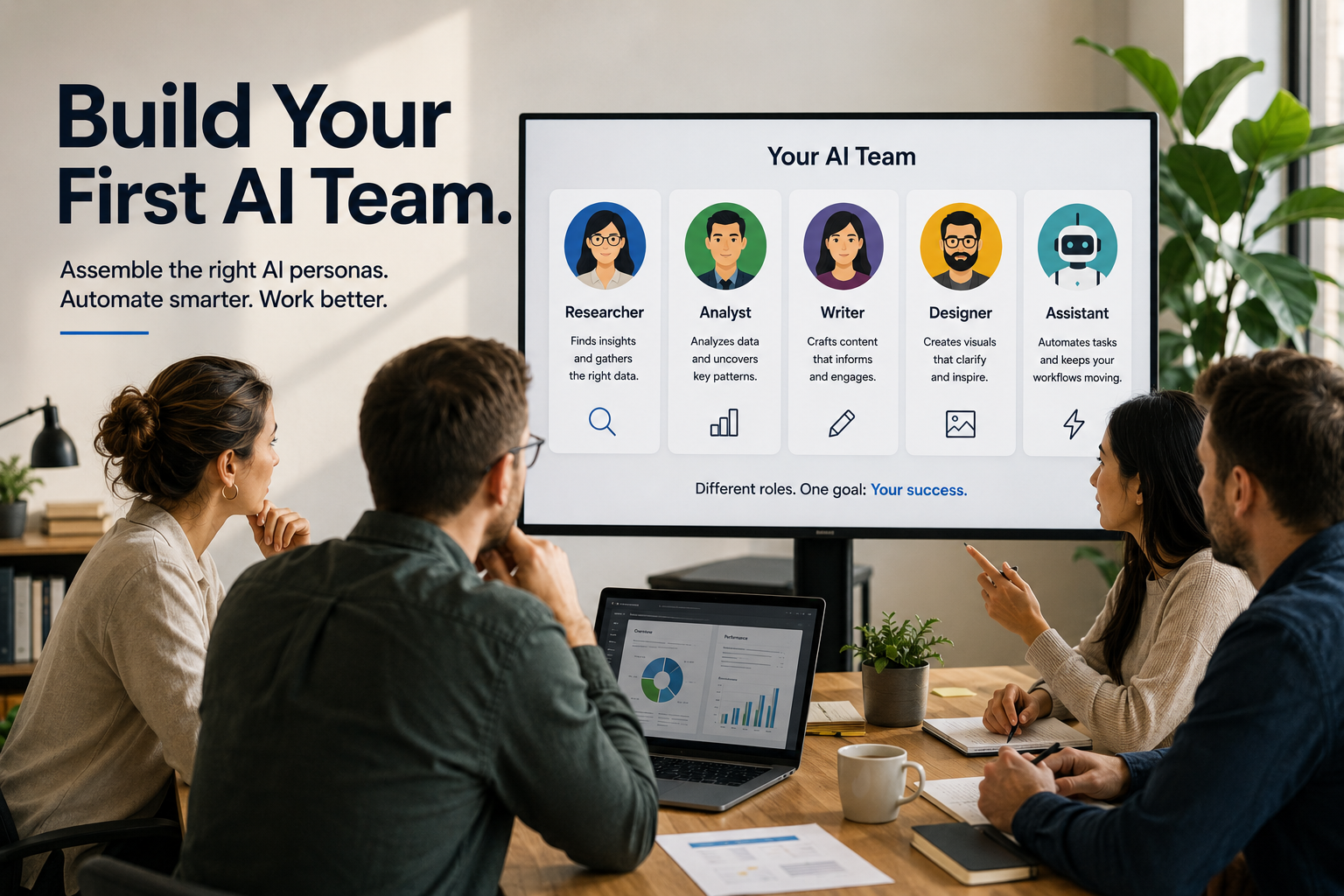
Image AI-generated for New Stardom

Available Now
By the end of 2026, analysts project that 40% of enterprise applications will feature task-specific AI agents. To remain competitive, business leaders must shift their mindset from managing individual AI tools to orchestrating collaborative AI teams.
This is your practical blueprint for designing, structuring, and onboarding your very first Multi-Agent Org Chart.
Why "Teams" Beat "Solo" AI
In a standard office workflow, a single AI agent is often expected to do everything: research data, write a report, check for compliance, and format the output. The problem? When a single large language model (LLM) is forced to perform multiple cognitive tasks in a row, accuracy plummets, hallucinations spike, and token usage skyrockets.
Multi-agent systems solve this through specialization.
Instead of one overwhelmed bot, you build a small department of specialized digital workers. Each agent is assigned a single, highly narrow role, a specific set of tools, and a defined boundary. They coordinate, pass files back and forth, and cross-verify each other’s work, exactly like a high-performing human team.
Designing the Org Chart: Three Essential Roles
To build your first virtual department, you need to define your digital "new hires." A basic, highly effective three-agent team for a marketing, research, or operations department consists of the following roles:
A. The Researcher (The Data Gatherer)
Role: Curate, extract, and clean raw data from external and internal sources.
Tools: Search APIs (like Serper), internal databases, and document readers.
System Prompt Directive:"You are an elite research analyst. Your sole job is to find verifiable, peer-reviewed, or primary source data. You do not write creative copy or format final reports. Pass raw, structured data tables to the Writer."
B. The Writer (The Builder)
Role: Synthesize raw research data into polished, user-friendly business assets.
Tools: Brand style guides, tone templates, and word processors.
System Prompt Directive:"You are a senior technical writer. You take structured data provided by the Researcher and draft comprehensive business briefs. Do not search the web or make assumptions. If data is missing, request it from the Researcher."
C. The Compliance Officer (The Gatekeeper)
Role: Act as the internal editor, legal check, and fact-verifier to eliminate hallucinations.
Tools: Style guidelines, compliance rulebooks, and fact-checking protocols.
System Prompt Directive:"You are a strict compliance and quality assurance manager. Review the Writer's draft against our company compliance checklist. Highlight any unverified claims, tone inconsistencies, or formatting errors. Reject the draft back to the Writer if it fails any metric."
Selecting Your Orchestration Platform
To make these agents communicate, you need an orchestration platform. Depending on your team's technical expertise, you have three primary options:
For Non-Technical Managers (Low-Code/No-Code): Use visual workflow builders like n8n or Microsoft Copilot Studio. They allow you to drag and drop visual nodes representing different agents, establish clear "if/then" branching logic, and integrate directly with daily tools like Slack, Google Sheets, or email.
For Moderate/Technical Users (The "Crew" Framework): Platforms like CrewAI allow you to define roles, goals, and backstories in clean, readable scripts. It is designed to let you set up hierarchical "crews" where a manager agent automatically delegates tasks to specialists in an afternoon.
For Developers (Custom Enterprise Scale): If you are building highly complex, stateful, and cyclic workflows, LangGraph has become the industry standard for custom Python-based agent architectures.The era of the simple chatbot is behind us. The companies winning the productivity race in 2026 aren't just giving their employees AI assistants, they are building coordinated, highly governed ecosystems of digital co-workers.
Setting the Boundaries: The "What I Don't Do" Rule
The biggest mistake managers make when onboarding AI teams is giving them too much freedom, which leads to "agentic sprawl" and runaway software costs. To run a successful team, you must establish strict operational guardrails.
The Gold Standard of Delegation: For every agent you deploy, you must write a list of explicit boundaries.
The "Least Privilege" Rule: Limit what data an agent can access. Do not give a research agent access to write database changes; give it read-only access.
The "What I Don't Do" Section: In your agent's system instructions, clearly state what is out of bounds. For example: "You do not reply to customer emails directly. You only draft the reply and save it as a draft for human review."
Define Loop Limits: Multi-agent teams can sometimes get stuck in an "infinite feedback loop" (e.g., the Writer drafts, the Compliance officer rejects, the Writer drafts again, endlessly). Set your platform's iteration cap to 15–20 loops maximum to prevent budget leaks on LLM API costs.
Your 30-Day Pilot Roadmap
Ready to build? Do not try to automate your entire operations team on day one. Instead, execute a controlled, high-value pilot:
Week 1 (Identify the Friction): Pick one highly repetitive, document-heavy process (e.g., generating weekly competitor analysis reports, drafting client onboarding briefs, or sorting customer IT tickets).
Week 2 (Build the Agents): Write clear, single-purpose roles for a Researcher, a Writer, and a Reviewer.
Week 3 (Set Up the Workflow): Use a tool like n8n or CrewAI to connect the agents, ensuring there is an "interrupt gate" where a human must review and click "Approve" before any output is finalized.
Week 4 (Run and Audit): Run 10-15 test cases. Measure the accuracy, the time saved, and identify where the agents got confused or went off-track. Optimize their system prompts accordingly.
The future of business isn't about finding the perfect AI prompt—it's about becoming an effective digital supervisor. By structuring your first multi-agent team today, you stop being a passive user of AI and start operating as an elite, automated department leader.
Have insights on AI and the future of work? Submit an opinion piece to New Stardom. Love work and career books? Explore our fun workplace book collection.
New Stardom covers the Future of Work, AI, and emerging job trends. Stay informed and explore more on New Stardom.