
The Rise of Agentic AI in Business Workflows
From reactive chatbots to autonomous operators: How the enterprise is grappling with "the chase and the catch" of AI agent adoption.
Job Trends Analysis | New Stardom

Image AI-generated for New Stardom

Available Now
For the past few years, artificial intelligence in the office has felt a lot like a very fast, very eager intern. You prompt it, it responds, you edit its work, and you repeat. But we are currently witnessing a profound paradigm shift: the transition from generative to agentic AI.
We are moving away from instruction-based tools that wait for a prompt, and toward intent-based, autonomous systems capable of reasoning, planning, and executing multi-step business workflows with minimal human intervention.
Yet, as we pass the midpoint of 2026, the corporate world is finding that adopting agentic AI is less of a plug-and-play upgrade and more of a fundamental restructuring of how work gets done.
Redesigning the Work
Many companies initially treated agentic AI as a glorified add-on, bolting autonomous agents onto legacy workflows to squeeze out incremental speed. However, recent research suggests that the real value lies in complete workflow redesign.
According to Stanford’s 51-Case Enterprise AI Playbook published earlier this year, companies that restructure their operating models around AI agents are achieving a 71% median productivity gain.
Rather than executing a single, rigid task, agents are given a high-level intent (e.g., "Reconcile Q2 vendor discrepancies under $5,000") and left to independently determine the most efficient path to achieve it.
Legacy Workflow: [Human finds error] -> [Human emails vendor] -> [Human waits] -> [Human updates ERP]
Agentic Workflow: [Agent detects error] -> [Agent negotiates with vendor AI] -> [Human approves resolution] -> [Agent updates ERP]
Read Next: Junior Employees Are Now Managing AI Agents
From "SaaSpocalypse" to Multi-Agent Collaboration
The rapid evolution of autonomous capabilities has sent shockwaves through the tech market. In early 2026, Wall Street experienced a minor panic, dubbed the "SaaSpocalypse", as investors feared that customized, code-generating AI agents would allow enterprises to build their own bespoke software, completely replacing traditional SaaS subscriptions.
While that extreme scenario hasn't fully materialized, it has forced major software vendors to reinvent themselves. Gartner projects that 40% of enterprise applications will have embedded, task-specific AI agents deployed by the end of 2026, compared to less than 5% in 2025.
Even more transformative is the rise of Agent-to-Agent (A2A) networks. Thanks to emerging open standards like the Model Context Protocol (MCP), which standardizes how LLMs connect to secure enterprise data, and the Agent2Agent Protocol, we are seeing specialized agents communicate and negotiate across different platforms and company boundaries.
Internal Efficiency: A customer service agent flags an out-of-stock item, automatically triggering a procurement agent to initiate a order.
External Negotiation: Your company's logistics agent can negotiate shipping terms directly with a supplier’s logistics agent, establishing a secure audit trail without human emails.Reclaiming Intellectual Agency in the Future of Work
The ultimate threat to the future of industry is the creation of a homogenized corporate ecosystem populated by individuals who can operate software but can no longer independently audit facts, challenge the status quo, or navigate systemic crises when the technology inevitably fails or suffers from data degradation. To maintain true intellectual agency, organizations must intentionally reintroduce friction into their workflows by mandating original thought during the initial drafting phases and utilizing automated tools strictly for refinement and polishing rather than foundational generation. Moving forward into this highly automated landscape, the definitive competitive advantage for any professional will not be their ability to navigate software platforms, but rather the possession of an independent mind that still understands how to think critically without external assistance.
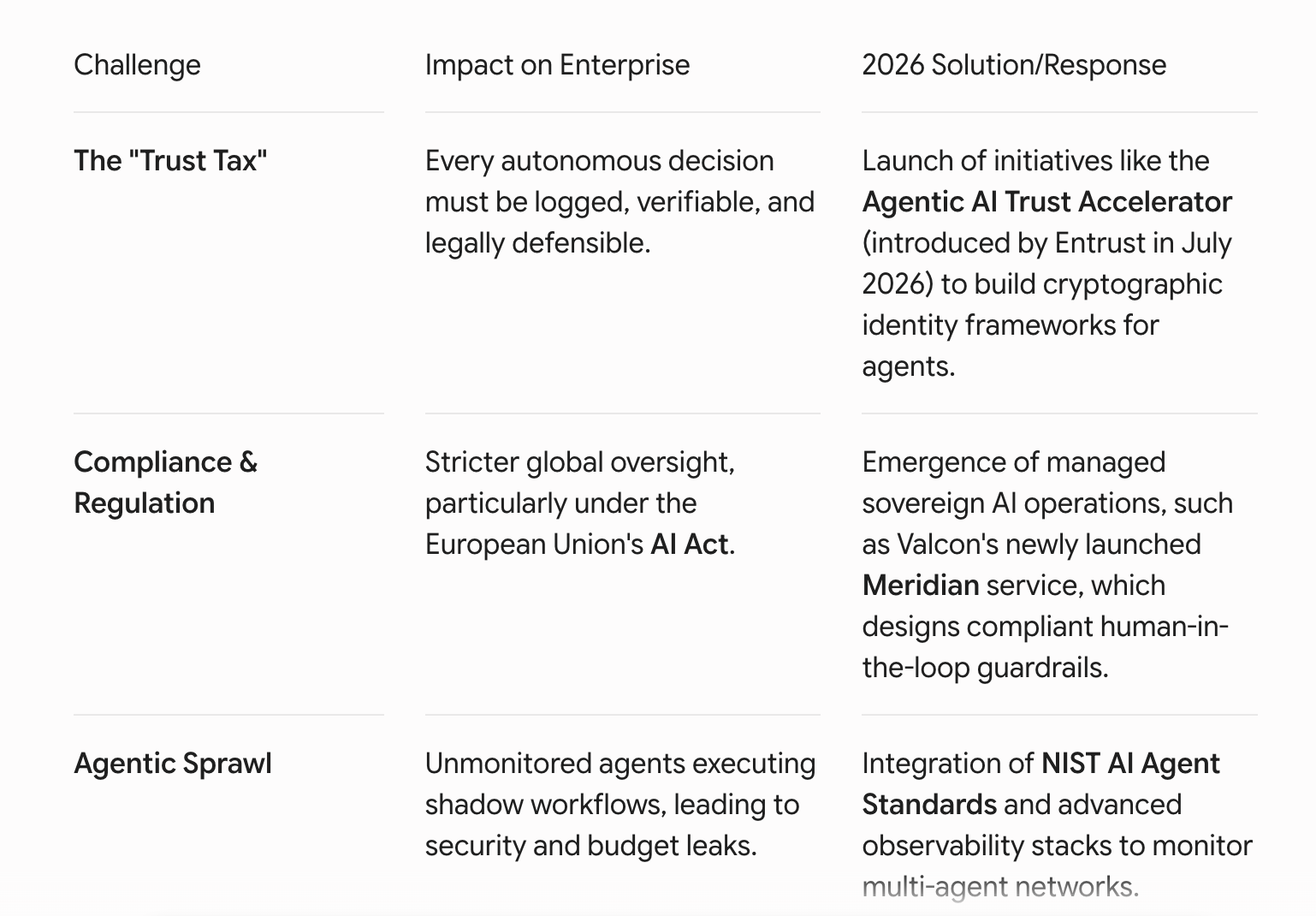
The "Trust Tax" and the Governance Gap
Despite massive enthusiasm, scaling agentic AI is hitting a major bottleneck: governance and security.
Forrester’s mid-2026 State of Agentic AI report revealed a striking paradox: while roughly 75% of enterprise leaders are actively pursuing agentic AI, only a small minority have scaled these systems into deep production. The rest are caught in "pilot purgatory".
Why? Because autonomous action introduces massive liability. If an AI agent has the credentials to access database APIs, make financial decisions, or contact clients, how do you manage its "identity"?
Building "Agentic Muscle" Responsibly
If your organization is looking to ride the wave of agentic automation, the consensus from the first half of 2026 is clear: start narrow, but build for scale.
Target the "Low-Hanging Fruit" First: Focus on high-repetition, low-risk internal functions (like contract compliance, data ingestion, or IT ticketing) rather than customer-facing systems.
Assign Every Agent an Identity: Treat an autonomous agent the same way you would a human employee. Give it unique credentials, limit its permissions to "least-privilege," and assign a named human owner who is legally and operationally accountable for its actions.
Design for "Human-on-the-Loop": Autonomy does not mean abandonment. The most successful workflows use "interrupt gates" where the AI drafts, plans, and executes, but waits for a human click before committing key financial or strategic decisions.
The era of the simple chatbot is behind us. The companies winning the productivity race in 2026 aren't just giving their employees AI assistants, they are building coordinated, highly governed ecosystems of digital co-workers.
Have insights on work and the future of work?Submit an opinion piece to New Stardom. Love work and career books? Explore our fun workplace book collection.
New Stardom covers the Future of Work, AI, and emerging job trends. Stay informed and explore more on New Stardom.
